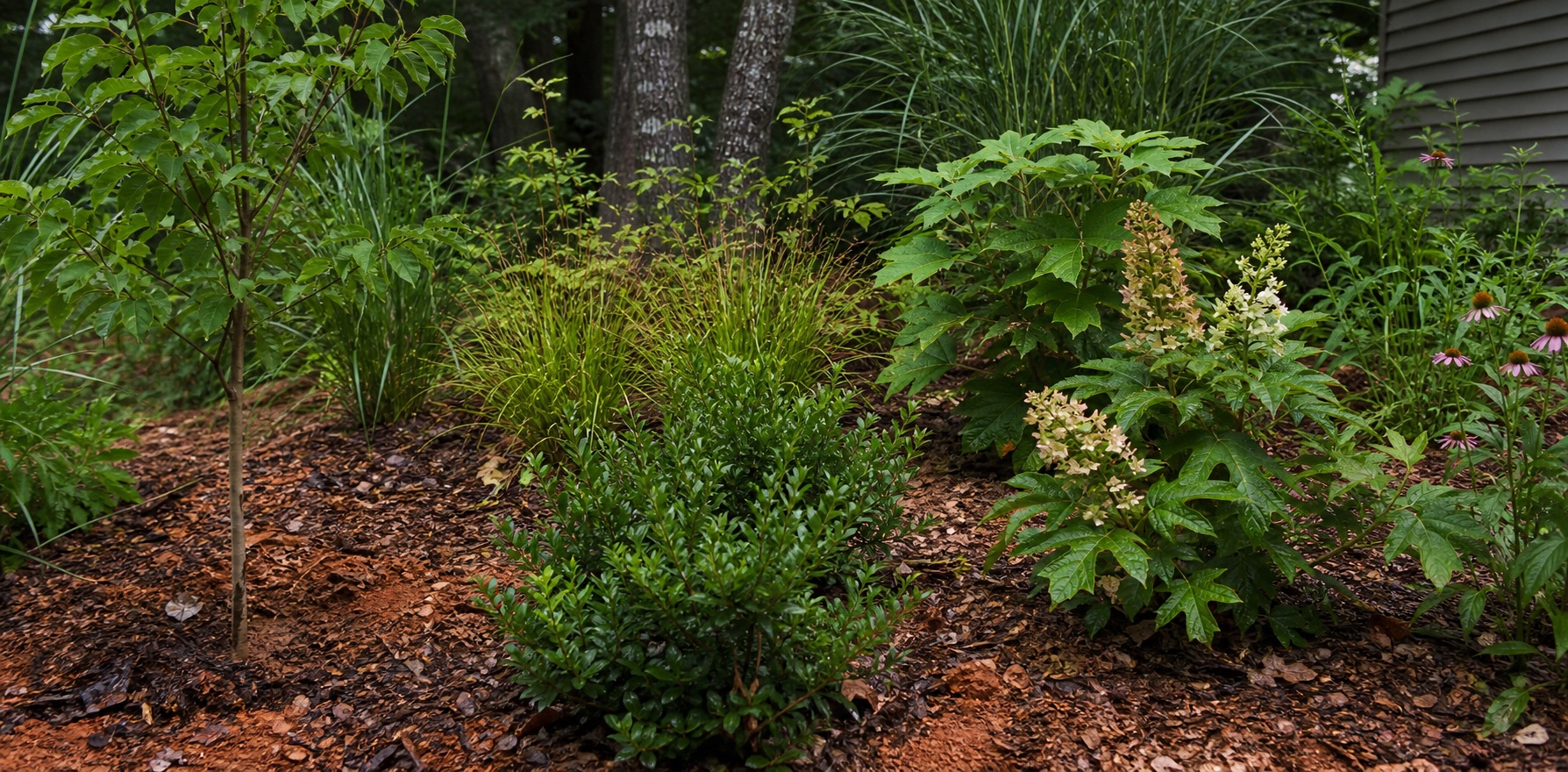
The short answer: choose plants only after checking sun, slope, compaction and how long the soil stays wet. Adaptable Raleigh-area candidates can include serviceberry, American hornbeam, fringetree, yaupon holly, oakleaf hydrangea, inkberry, switchgrass, river oats, asters and black-eyed Susan—but each belongs to a different combination of light and moisture.
First, diagnose the bed—not just the texture
Clay particles are small and hold water and nutrients well. The problem many Raleigh homeowners call “clay” is often clay plus construction compaction, lost topsoil, buried debris or poor grading. NC State Extension notes that compaction reduces the pore space roots need for air, water movement and growth.
- Watch after rain. Does water soak in, run off or remain for days?
- Check several depths. A loose top layer can hide dense subsoil below.
- Map the light. Morning sun, hot western exposure and dry shade are different sites.
- Notice roots and traffic. Mature-tree competition and repeated foot traffic can make clay much drier and denser.
- Test pH and nutrients. Use an NC Department of Agriculture soil test rather than adding lime or fertilizer by habit.
Adaptable plants to investigate
This is a starting palette, not a shopping list. Confirm each plant’s mature size and exact cultural needs in the NC State Extension Gardener Plant Toolbox.
| Site condition | Plants worth investigating | Design role |
|---|---|---|
| Part shade, moist to average soil | American hornbeam, serviceberry, oakleaf hydrangea, Virginia sweetspire | Small trees and layered shrub structure |
| Sun, average to seasonally dry soil | Eastern redbud, fringetree, yaupon holly, switchgrass, little bluestem | Structure, screening and movement |
| Moist low areas that still drain | Possumhaw viburnum, inkberry, swamp milkweed, turtlehead, soft rush | Rain-garden and moisture-tolerant planting |
| Woodland edge and shade | American holly, Christmas fern, river oats, woodland phlox, green-and-gold | Understory layers and ground coverage |
| Sunny perennial border | Black-eyed Susan, aromatic aster, mountain mint, goldenrod, ironweed | Seasonal color and pollinator support |
Some plants tolerate clay but not standing water. Others tolerate periodic wetness but fail in a permanently saturated hole. “Clay tolerant” never cancels the need to match drainage.
How to prepare clay without creating a bathtub
Work a planting area rather than replacing only the soil inside each planting hole. A pocket of loose amendment surrounded by dense clay can hold water around roots. Preserve natural soil structure where it is healthy, relieve compaction where practical and use organic matter at an appropriate scale.
NC State Extension cautions that changing soil texture with sand requires impractically large quantities; small additions can create an undesirable mix. Compost supports soil structure, but it does not repair bad grading or provide an outlet for runoff.
Four common clay-soil mistakes
- Buying every plant marked “clay tolerant” without separating wet clay from dry clay.
- Adding gravel to the bottom of a planting hole and assuming it creates drainage.
- Planting too deeply because the soil settles after installation.
- Improving plant selection while ignoring roof runoff, low grades or compacted construction routes.
Build a community, not a collection
Choose a few structural trees and shrubs first. Repeat dependable perennials and grasses through the bed, then add smaller accents for seasonal detail. Repetition makes the garden legible and easier to maintain, while diversity across layers supports resilience and habitat.
For native-forward work, NC State Extension emphasizes “right plant, right place”: native status alone does not make a plant suitable for an urban bed. The site still decides.
Raleigh planting design
Turn difficult soil into a site-right garden.
Garden & Art reads the soil, light, water and existing canopy before composing a plant palette for your property.
Plan a native-forward garden