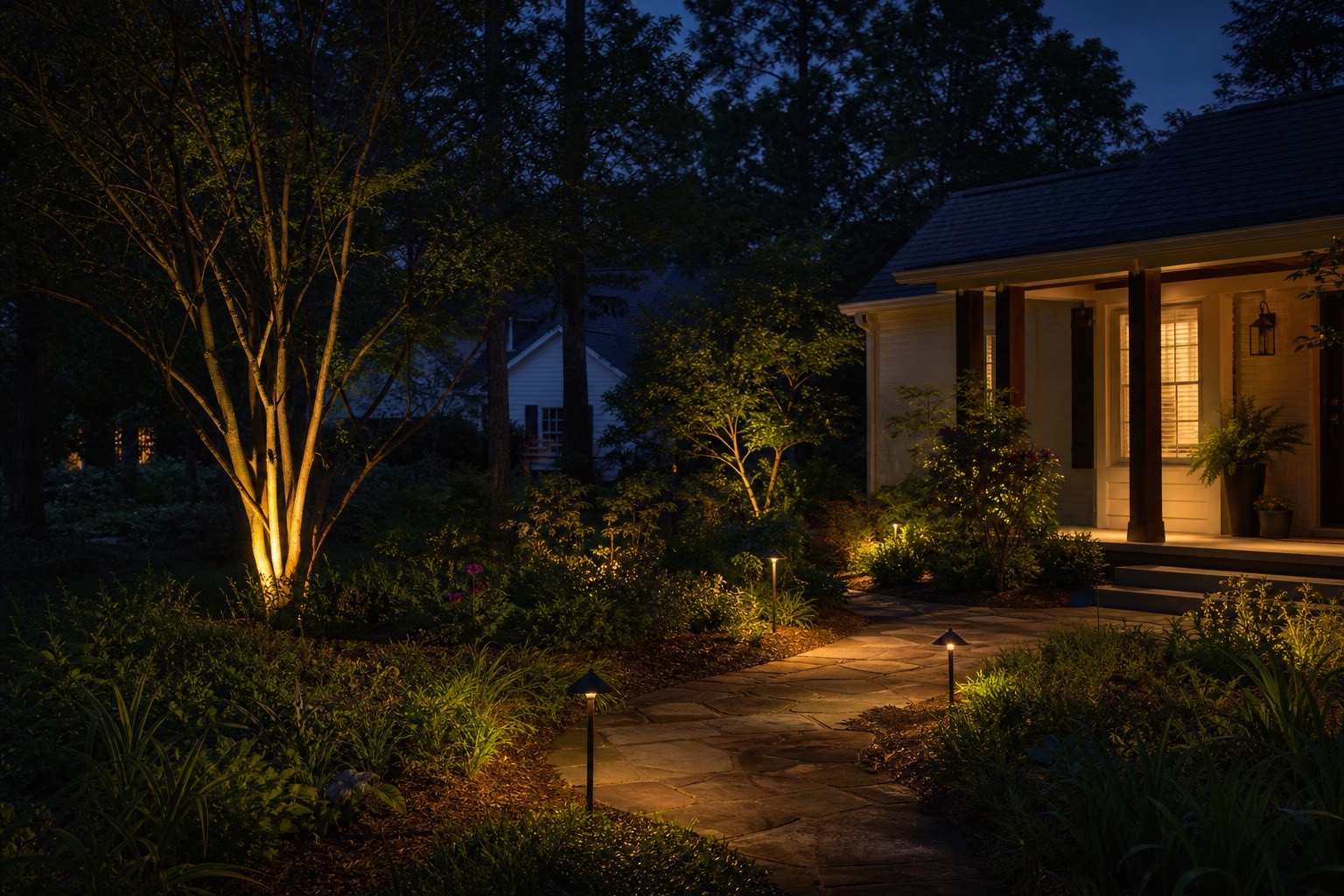
The short answer: start with paths, steps, entrances and the places you actually use. Then add a small number of accents for trees, walls or planting. Landscape lighting cost is driven by fixture quality and count, transformer and controls, wire runs, installation conditions and the care required to aim and commission the system.
Five useful landscape lighting ideas
- Mark changes in level. Illuminate steps, wall edges and transitions without putting glare in a person’s eyes.
- Guide, rather than outline, a path. Stagger low shielded fixtures at decision points instead of creating a runway of evenly spaced lights.
- Choose one or two specimen trees. Aim carefully and keep output low enough to preserve shadow and depth.
- Use walls and eaves for soft reflected light. A controlled wash can make a small patio feel more comfortable than a bright overhead source.
- Put each zone on useful controls. Arrival lighting, outdoor-living lighting and accents do not always need to run together or all night.
What changes landscape lighting cost
| Cost driver | Why it matters | What to confirm |
|---|---|---|
| Fixture construction | Materials, optics, shielding and replaceable components affect durability and light quality. | Model numbers, finish, beam spread, warranty and color temperature. |
| Fixture count | Each light adds equipment, wire, connectors, installation and aiming time. | A fixture schedule tied to a plan—not only a lump-sum total. |
| Transformer and controls | Capacity, zoning, astronomical timers and smart controls shape operation. | Spare capacity, locations and who can adjust the schedule. |
| Wire routes | Long runs, hardscape crossings and root-sensitive areas require more care. | How wires cross walks and how mature roots will be protected. |
| Existing landscape | Working in a finished garden is different from installing before paving and planting. | What disturbance and restoration are included. |
| Commissioning | Nighttime aiming and follow-up adjustment are essential to the final result. | Whether a dusk adjustment visit is included. |
A useful estimate separates equipment and scope clearly enough to compare. An unusually low fixture allowance may omit controls, hardscape crossings, nighttime aiming or restoration. An unusually high count may simply be over-lighting the garden.
How to compare lighting quotes
- Compare the plan and intended effect before comparing fixture count.
- Ask for manufacturer and model information rather than accepting “LED uplight.”
- Confirm transformer capacity, control zones and operating schedule.
- Identify wire crossings, sleeves and areas where hand work is needed.
- Ask what happens if a fixture is moved after the first nighttime review.
- Confirm warranty coverage for fixtures, lamps or integrated LEDs, transformer and labor.
Use less light, more carefully
DarkSky International recommends that outdoor light be useful, targeted, low-level, controlled and warm-colored. Its home-lighting guidance recommends fully shielded fixtures and warmer light—generally 2700K or lower—plus timers or sensors where appropriate. Those principles reduce glare and spill while often reducing the number or output of fixtures.
The U.S. Department of Energy likewise emphasizes efficient LED equipment and controls. Efficiency is only part of the design: a bright efficient fixture aimed into a window is still a poor result.
A simple planning checklist
- Walk the property at night and list the places that truly need light.
- Prioritize safe movement and entrances.
- Choose a restrained set of garden features to reveal.
- Keep sources shielded from normal viewpoints and neighboring windows.
- Use warm color and the lowest useful output.
- Plan controls so decorative zones can turn off earlier.
- Schedule a nighttime aiming and adjustment visit.
Raleigh landscape lighting
Design the nighttime garden as carefully as the daytime one.
Garden & Art integrates lighting with paths, patios, planting and the way homeowners use the landscape.
Explore landscape lighting