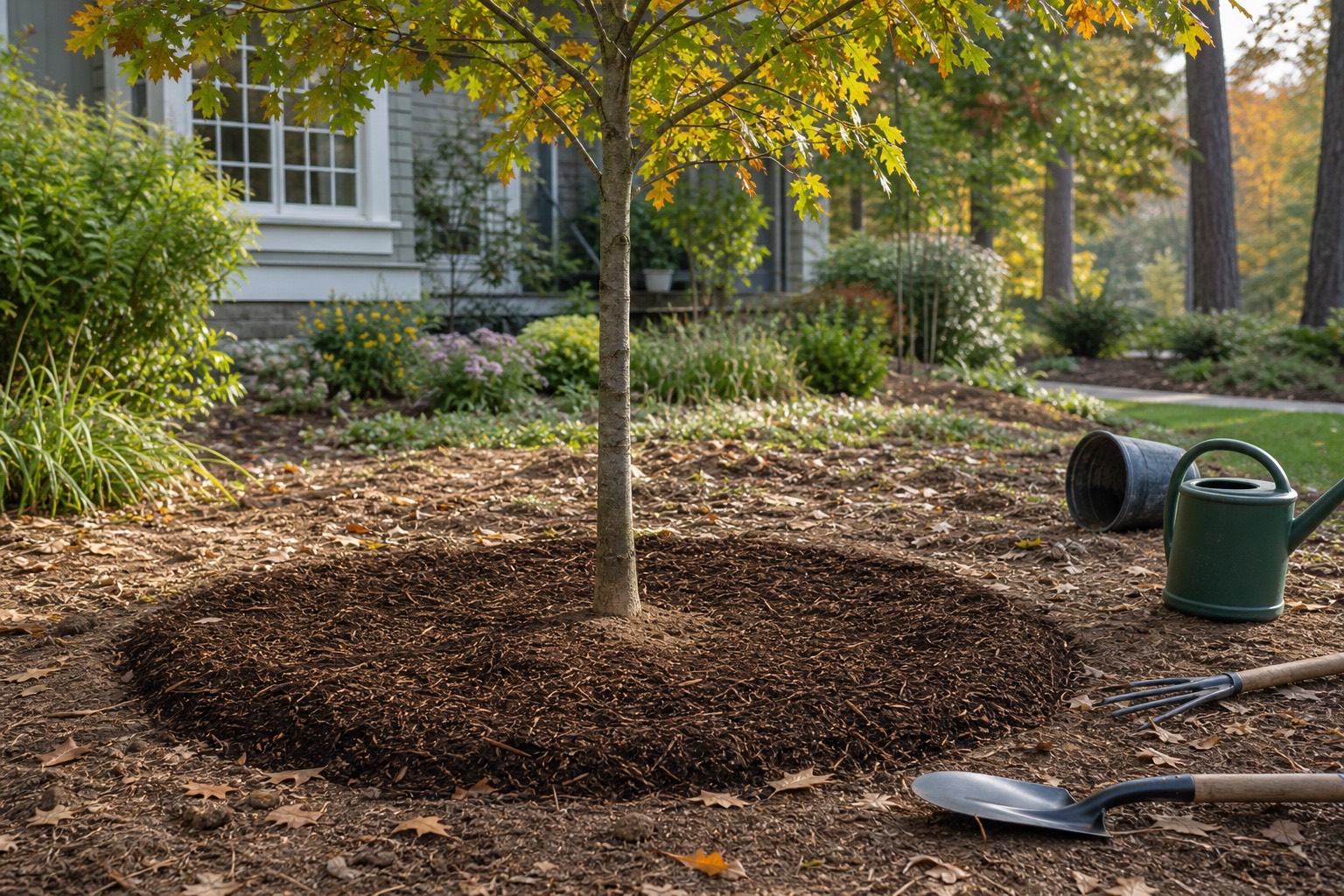
The short answer: fall is often the best time to plant hardy landscape trees and shrubs in North Carolina’s Piedmont because soil remains warm while air temperatures moderate. Early spring is the usual second choice. Avoid planting into frozen, saturated or extremely dry soil and plan around the specific plant and its root system.
Why fall often works well
NC State Extension explains that fall planting pairs warm soil, which supports root growth, with cooler air, which reduces demand from shoots and leaves. Roots can continue developing after top growth slows and can resume before spring budbreak. That head start helps before the first hot summer.
Fall planting does not eliminate watering. Piedmont autumns can be dry, and a newly installed root ball occupies only a small volume of soil. Monitor the root ball and surrounding soil through winter whenever the ground is not frozen.
When another window may be safer
| Situation | Planning response |
|---|---|
| Broadleaf evergreen or cold-sensitive plant | Allow enough establishment time before hard freezes, or use spring when local guidance and species needs favor it. |
| Bare-root plant | Plant while dormant and promptly after receipt; do not let roots dry. |
| Container-grown tree or shrub | Can offer a wider window, but circling roots and a dry root ball require correction and close watering. |
| Heavy, saturated clay | Wait until soil is workable; planting into smeared, waterlogged soil damages structure and oxygen supply. |
| Summer installation | Possible with careful handling and irrigation, but heat increases stress and the cost of missed watering. |
| Large transplant | Coordinate species, root preparation, equipment access and aftercare with a qualified professional. |
The hole and depth matter more than fertilizer
- Find the trunk flare and the top of the structural roots; do not assume the top of the nursery soil is correct.
- Dig a broad hole, but keep the root flare at or slightly above surrounding grade as site drainage requires.
- Set the root ball on firm, undisturbed soil so it does not sink.
- Remove or correct circling, kinked and girdling roots as appropriate for the stock.
- Backfill primarily with existing soil unless a site-specific specification says otherwise.
- Water thoroughly to settle soil and remove large air pockets.
Do not plant a tree deeply to make it feel stable. If support is genuinely needed, stake loosely and remove the supports on schedule. Trunk flare buried by soil or mulch can contribute to poor establishment and future root problems.
Water the root ball, then expand outward
During establishment, the original root ball can dry while adjacent clay remains damp—or stay wet while the surrounding surface looks dry. Check moisture in both places. Apply water slowly enough to soak the root zone without running off, then adjust for rainfall, soil, plant size and season.
Use a broad mulch ring to moderate moisture and protect the trunk from mowers. Keep mulch off the trunk and root flare. The goal is a shallow, wide layer, not a volcano.
A practical Piedmont calendar
| Season | Typical use | Main caution |
|---|---|---|
| September–November | Preferred window for many hardy trees and shrubs once extreme heat eases. | Drought can continue; water consistently and do not rush tender plants before winter. |
| December–February | Dormant planting can work when soil is not frozen or saturated. | Availability, species sensitivity and wet clay may limit work. |
| March–April | Strong second window before summer heat. | Spring growth increases water demand quickly. |
| May–August | Use when schedule requires and irrigation/aftercare are dependable. | Heat, transplant stress and rapid drying create the highest risk. |
Raleigh trees and gardens
Choose the plant, place and season together.
Garden & Art designs planting that accounts for mature size, site conditions and the care each plant needs to establish.
Explore native garden design