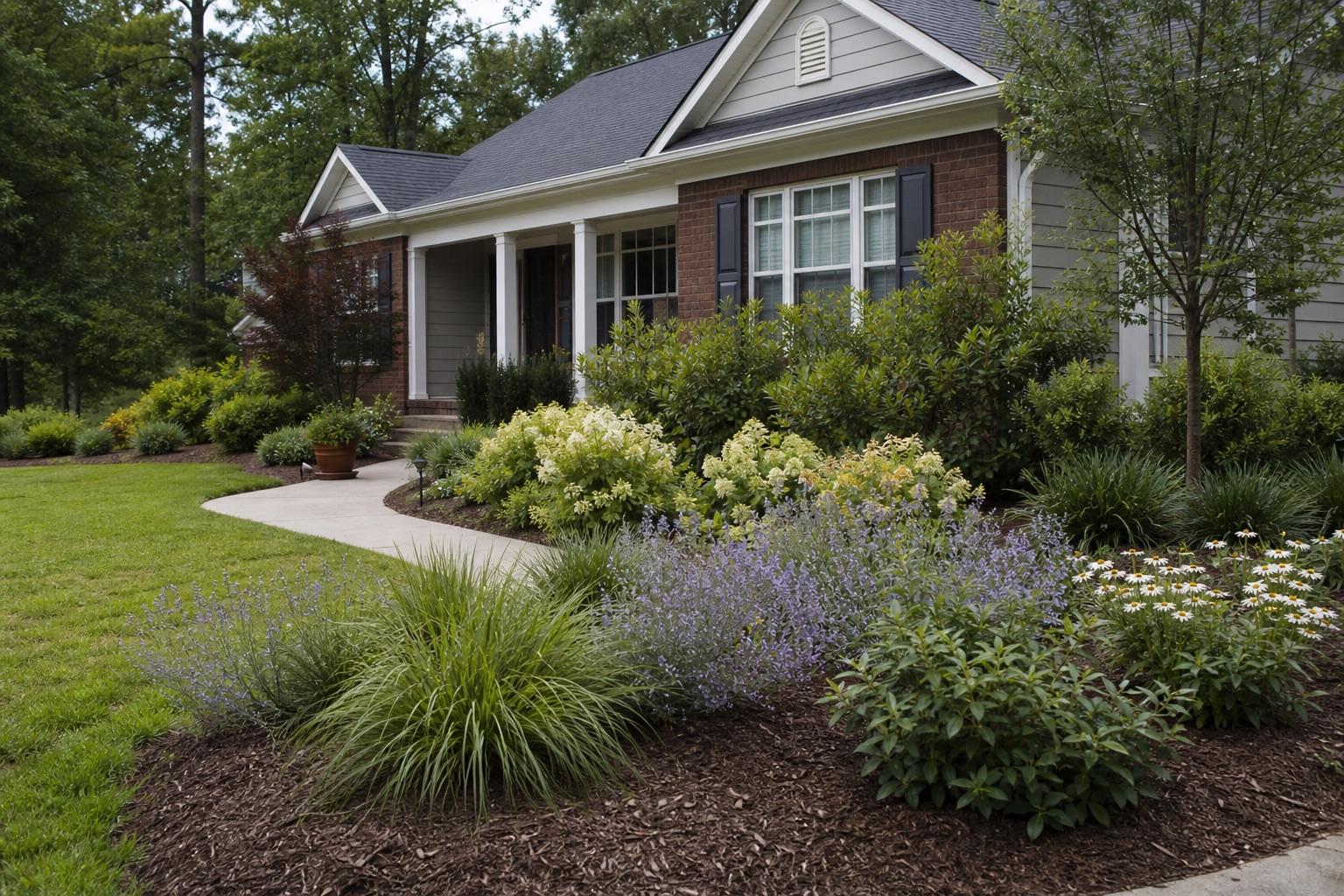
The short answer: reduce high-effort lawn where it performs poorly, simplify mowing and bed edges, group plants by water needs, choose plants at their mature size, cover soil with living plants or mulch, and make every maintenance area easy to reach. Low maintenance comes from removing repeated problems—not from eliminating plants.
Low maintenance is not no maintenance
Every living landscape changes. Trees grow, perennials spread, leaves fall and weeds arrive. A “maintenance-free” promise usually hides future work: rock collects organic debris, weed fabric becomes tangled with roots and small shrubs repeatedly outgrow spaces chosen for their nursery size.
A better goal is a landscape where the work is predictable, safe and proportionate to the value it provides. NC State Extension’s landscape-design guidance recommends reducing awkward lawn, avoiding tight corners, choosing plants whose mature size fits and grouping plants with similar water needs.
Seven ideas that genuinely reduce work
1. Keep lawn where lawn earns its place
Retain turf for play, open views and useful circulation. Replace narrow strips, steep banks and deep shade where mowing is difficult or grass repeatedly thins. A larger bed is not automatically easier, but a coherent bed can eliminate weekly conflicts with roots, edges and inaccessible corners.
2. Simplify the mowing line
Broad curves and connected beds are faster to mow than scattered tree rings and tight angles. A continuous edge also looks intentional when the garden is between bloom seasons.
3. Choose plants at mature size
A shrub that naturally reaches eight feet will not become a four-foot shrub because the label is optimistic. Right-sizing plants reduces shearing, crowding, blocked windows and premature replacement.
4. Group plants by water and light
Put plants with similar needs together. Irrigation can then serve the bed instead of rescuing individual plants, and a dry-zone plant will not sit beside a species that needs consistently moist soil.
5. Use layers to occupy the ground
Trees, shrubs, perennials, grasses and groundcovers can form a stable community. Mulch is useful during establishment, but bare mulch is an open invitation for weeds. As plants fill their intended space, they shade more soil and reduce opportunities for unwanted seedlings.
6. Solve water before planting
A wet corner does not become low maintenance when filled with “water-loving” plants if runoff is eroding the bed or remaining against the house. Trace the source, understand overflow and then choose whether grading, drainage or a planted basin fits. Our standing-water guide explains the diagnostic sequence.
7. Design access into the garden
Stepping routes, hose access, sensible bed depth and a place for leaves or compost make routine care easier. If every task requires stepping over plants or dragging a hose through them, the design is generating maintenance.
Three shortcuts that often create more work
| Shortcut | Why it disappoints | Better direction |
|---|---|---|
| Weed fabric under ornamental beds | Soil and roots accumulate above it, making future edits harder. | Prepare the bed, mulch appropriately and establish a dense plant layer. |
| Gravel everywhere | Leaves and soil settle into the stone; weeds still germinate and removal is difficult. | Use stone where it serves circulation, drainage or a deliberate design purpose. |
| Rows of tightly sheared shrubs | Frequent trimming is required to hold plants below their natural size. | Select shrubs for their mature dimensions and let their form contribute. |
A practical low-maintenance front-yard pattern
Begin with one legible arrival path and preserve the lawn only where it creates useful openness. Connect isolated foundation beds into a larger planted area, keeping clear sight lines at the driveway and walk. Use a small number of structural shrubs, repeat durable perennials and grasses, and place the most detailed planting where people pass close enough to enjoy it.
This approach gives the front yard year-round form without requiring every square foot to perform at the same intensity. The quiet areas support the focal areas.
Build the maintenance level into the brief
Before selecting plants, decide how often you realistically want to mow, prune, weed, water and divide perennials. Decide whether seasonal cutback will be done all at once or gradually, and whether professional garden care is part of the plan. Those answers should shape the layout and palette from the beginning.
A garden that fits your life
Reduce recurring work without reducing the garden.
Garden & Art can redesign a Raleigh yard around clear structure, site-right planting and the level of care you actually want to provide.
Explore landscape design