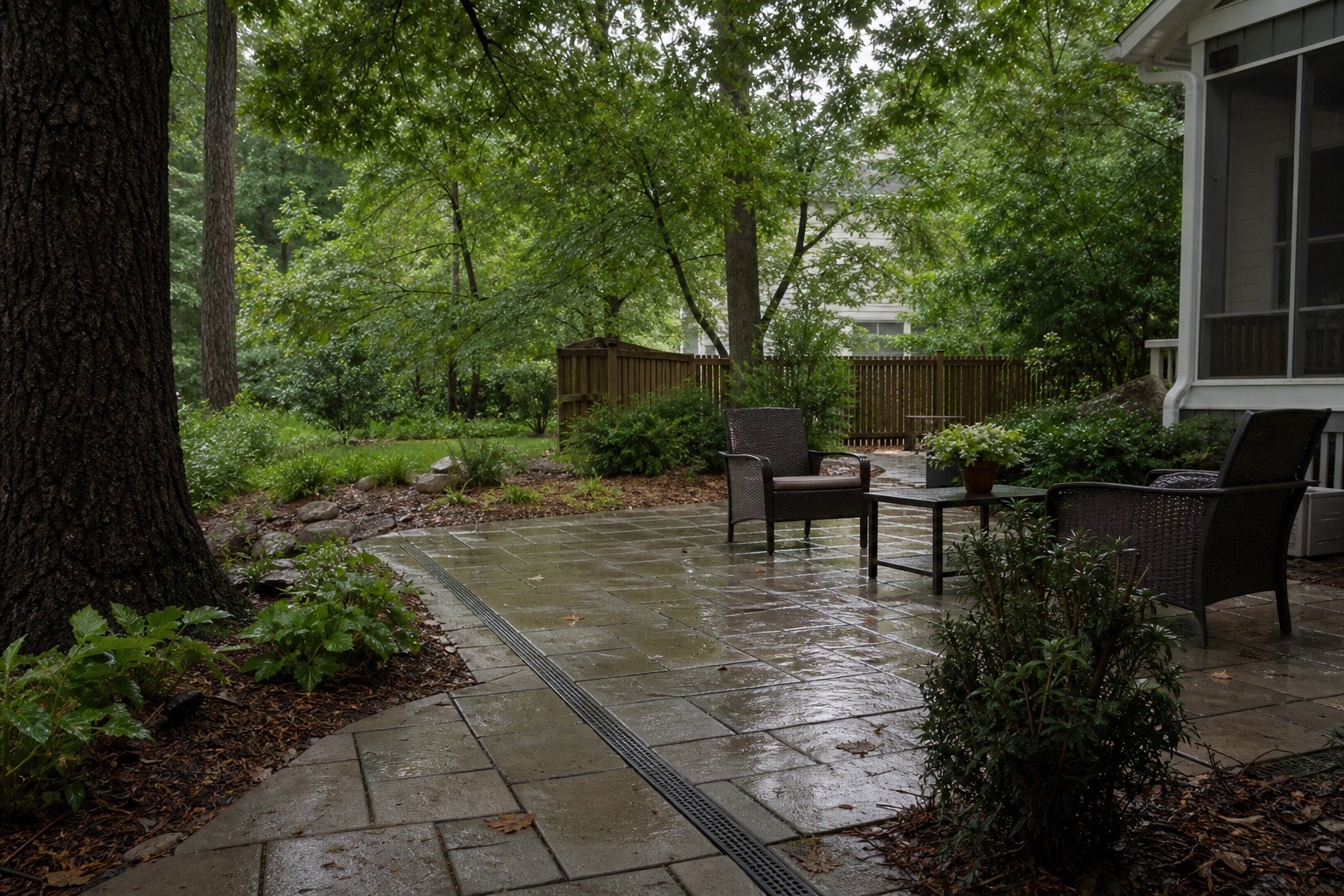
The short answer: a durable patio drainage plan pitches the finished surface away from structures, prevents low spots, protects the base from trapped water and sends runoff to a lawful, stable outlet. A channel drain or permeable system may help, but neither can replace correct grading and a destination for the water.
What the drainage plan needs to show
| Part | Question it answers | What to avoid |
|---|---|---|
| Existing grades | Where does roof, lawn and uphill runoff arrive now? | Designing the patio as if surrounding water does not exist. |
| Finished surface | Which direction will water travel across the patio? | Flat areas, reverse pitch toward the house and isolated low pavers. |
| Edges and thresholds | Can water pass a step, wall, bed or door safely? | A raised edge that turns the patio into a shallow basin. |
| Base and bedding | Can the pavement remain supported through wet conditions? | Building over soft soil or allowing fines to contaminate the aggregate. |
| Drain or underdrain | Is collection needed where gravity alone cannot clear the surface? | A drain with no cleanout, inadequate capacity or no dependable outlet. |
| Discharge | Where does water go without harming a building, slope or neighbor? | Concentrating flow at a property line or erosion-prone bed. |
The Concrete Masonry & Hardscapes Association’s technical guidance treats surface and subsurface drainage as part of pavement design. Exact slope and drainage details vary with the paver system, site and manufacturer; a single percentage copied from another project is not a complete design.
Why Raleigh clay changes the conversation
Many Triangle sites contain clay-rich or compacted subsoil that accepts water slowly. Water moving through paver joints or reaching the base may not disappear into the ground as quickly as it would in sandy soil. The design may need a graded aggregate base, edge restraint, separation from subgrade soil and—where appropriate—an underdrain to a suitable outlet.
Permeable pavers are a stormwater system, not simply conventional pavers with wider joints. CMHA guidance notes that low-infiltration soil can require perforated underdrains. Soil testing, storage depth, overflow and maintenance all matter.
What common patio drainage problems look like
- Water remains on the surface long after the surrounding pavement dries.
- Pavers settle along a trench, edge or downspout route.
- Runoff crosses a doorway, crawlspace vent or foundation wall.
- Joint material repeatedly washes out in the same path.
- A drain backs up because the outlet is buried, crushed or too high.
- The patio stays dry only because water is being sent to a neighbor or unstable slope.
Questions to ask before patio construction
- What happens here during a heavy summer storm?
- What finished elevations will be set at the house, doors and patio edges?
- Will roof water cross the patio or be routed separately?
- What supports the pavers and keeps the base from mixing with clay?
- If a drain is included, where is its outlet and how is it cleaned?
- Could the work affect an easement, neighboring property or mature tree roots?
Raleigh patios and drainage
Plan the paving and the water together.
Garden & Art designs and builds residential patios with the surrounding grade, planting and drainage in view.
Explore Raleigh hardscaping