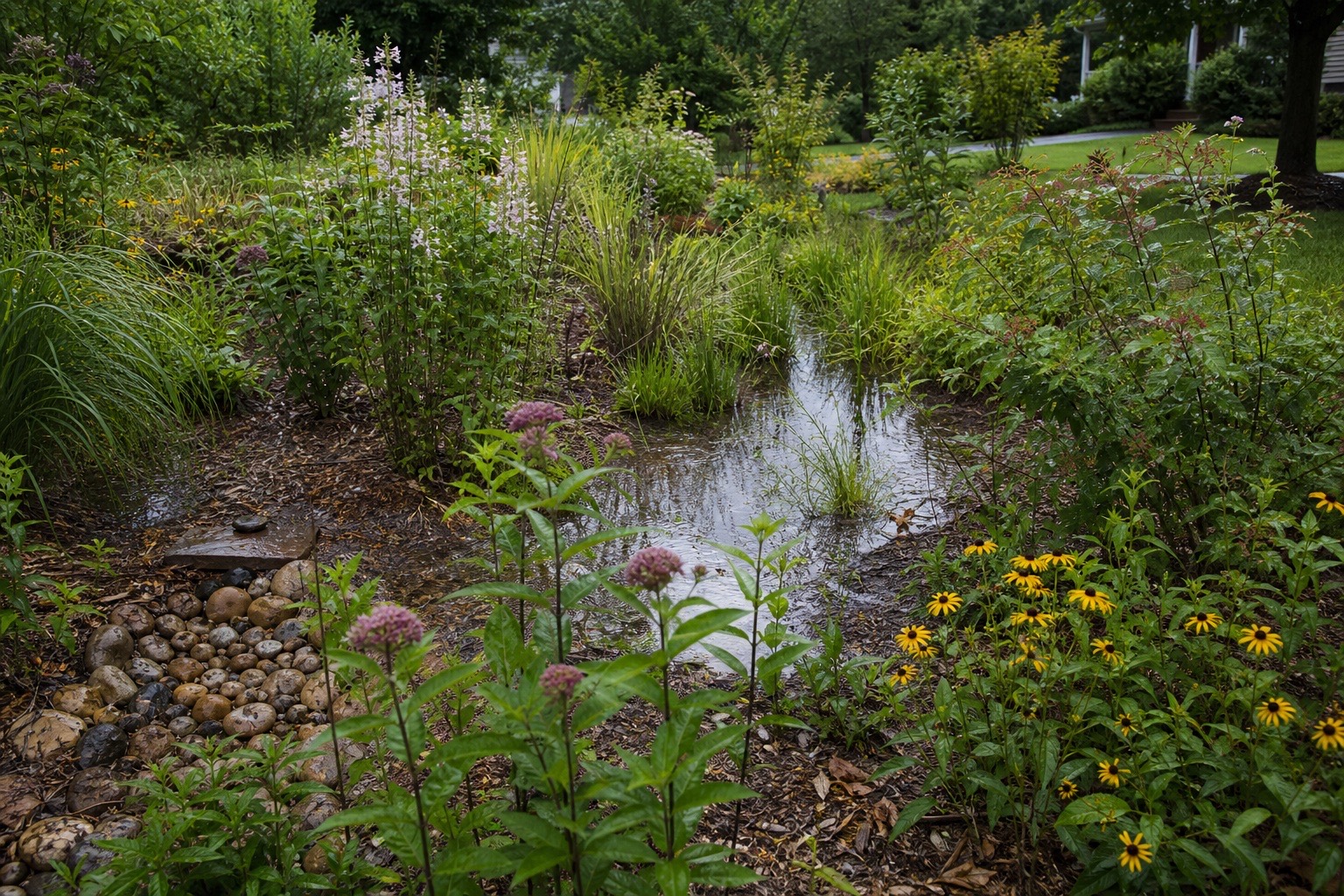
The short answer: match each plant to the rain garden’s bottom, side slope or upper edge, then filter by sun, mature size and soil. Useful North Carolina examples include swamp milkweed and turtlehead for wetter areas, river oats and sweet pepperbush where conditions fit, and black-eyed Susan on better-drained edges.
Think in moisture zones
| Zone | Typical condition | Plant traits to seek |
|---|---|---|
| Bottom | Receives runoff first and stays wet longest after a storm. | Tolerates periodic standing water but also survives when the basin drains. |
| Side slope | Moist during storms, then drains sooner than the bottom. | Handles variable moisture and helps hold the basin edge. |
| Upper edge | Usually the driest part; may resemble a normal garden bed. | Tolerates ordinary site moisture and occasional splash or overflow. |
Observe the garden after several storms. Water should not remain indefinitely; persistent ponding can indicate poor infiltration, incorrect sizing, a blocked outlet or a site that needs a different stormwater approach.
North Carolina plants to investigate
| Plant | Useful role | Important check |
|---|---|---|
| Swamp milkweed Asclepias incarnata | Upright summer perennial for moist, sunny areas; supports pollinators. | Needs enough sun and room for its mature height. |
| White turtlehead Chelone glabra | Moisture-tolerant perennial with late-season flowers. | Best placement depends on sun and consistent soil moisture. |
| River oats Chasmanthium latifolium | Adaptable native grass for part shade and variable moisture. | Can seed freely; use where spread is acceptable. |
| Sweet pepperbush Clethra alnifolia | Fragrant flowering shrub for moist acidic soil. | Choose a cultivar whose mature size fits the space. |
| Blackhaw viburnum Viburnum rufidulum | Larger woody structure, flowers and fruit. | Too large for many small basins; place with mature dimensions in mind. |
| Black-eyed Susan Rudbeckia hirta | Sunny color and pollinator value on better-drained portions. | Short-lived behavior and moisture tolerance vary by setting. |
These are starting points, not a universal shopping list. NC State Extension’s plant database can filter by North Carolina region, light, soil moisture, size and other traits. Verify the botanical name at purchase because common names can refer to several plants.
Design the water before selecting plants
NC State Extension recommends locating rain gardens where runoff can reach them, away from foundations, wells, septic areas and utilities, and above the seasonal water table. The garden’s size and soil preparation depend on the drainage area and infiltration. Do not assume that adding sand to Raleigh clay creates safe drainage; poorly mixed sand and clay can make a dense, concrete-like soil.
Map sun over the growing season. A site below deciduous trees may be sunny in winter but shaded when summer storms and plant growth are at their peak.
Common planting mistakes
- Putting every moisture-loving plant in the deepest zone without checking its drought tolerance.
- Choosing only flowers and omitting roots, grasses, shrubs and winter structure.
- Planting a large shrub where it will block an inlet or overflow.
- Using one species throughout, so one pest or weather event can leave the basin bare.
- Covering stems with deep mulch or allowing floating mulch to clog the outlet.
- Treating a failed drainage area as a rain garden without testing the site.
A practical planting plan
- Draw the inlet, basin, side slopes, overflow and access for maintenance.
- Mark bottom, slope and upper-edge moisture zones.
- Record summer sun and shade.
- Choose a small matrix of grasses or sedges for continuity.
- Add repeating groups of perennials across bloom seasons.
- Use shrubs only where mature width and height fit.
- Plan for weeding, sediment removal and replacement during establishment.
Raleigh rain gardens
Make the stormwater feature feel like a garden.
Garden & Art combines drainage observation, grading and regionally appropriate planting in residential rain-garden design.
Explore drainage and rain gardens