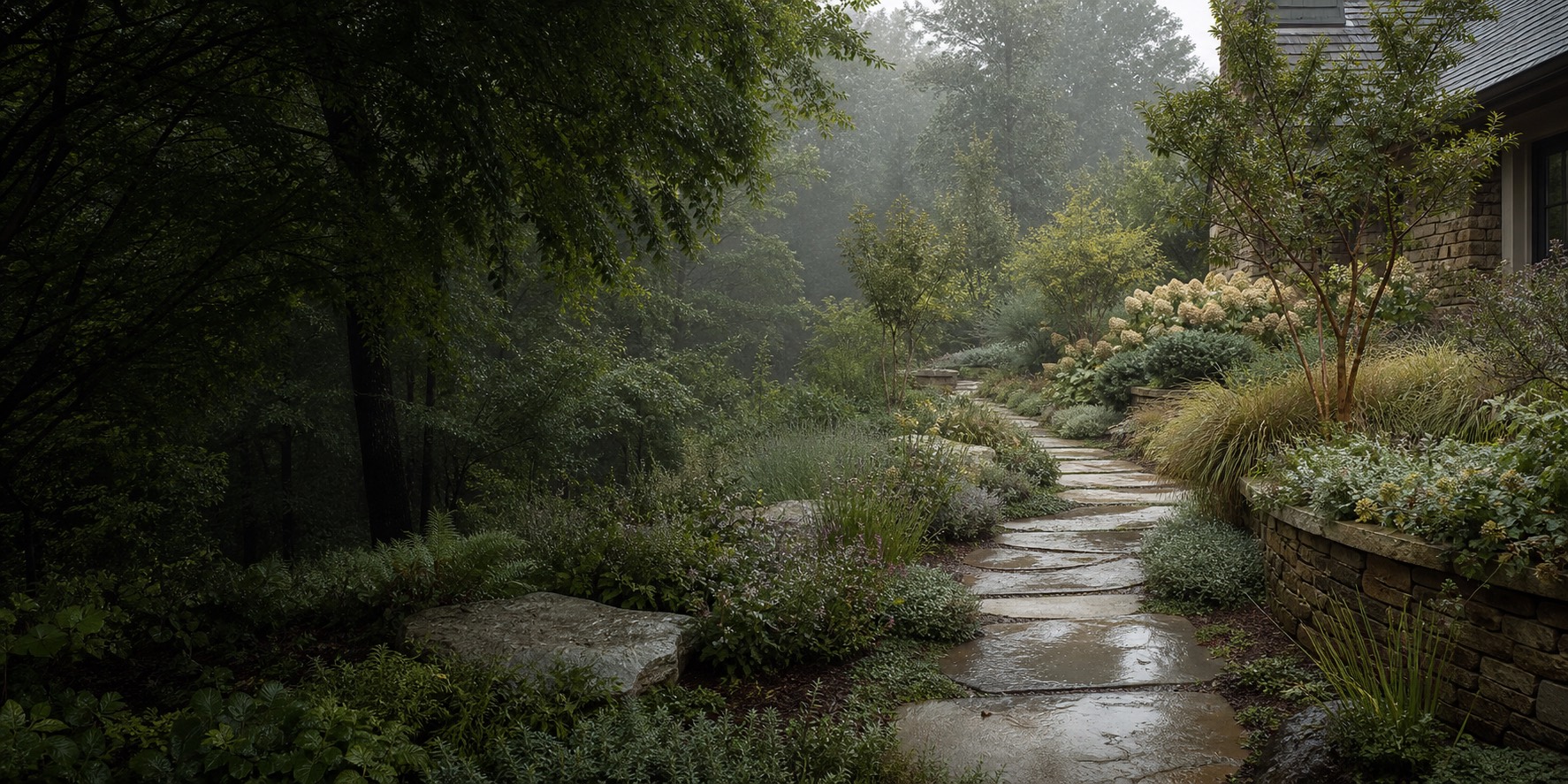
The short answer: Start a Raleigh front-yard design with a clear path to the door, year-round structure, planting matched to light and drainage, and an honest maintenance plan. Keep utilities and mature trees visible in the plan, then use fewer materials and repeated plant groups to create a calm, coherent landscape.
Make the route to the door obvious {#arrival}
A front yard works first as an arrival sequence. Guests should understand where to park, which path to follow and where the entrance is without studying the landscape. A direct route can still curve, widen or pass through planting, but it should not feel accidental.
Begin by observing how people already move. Look for worn grass, awkward shortcuts, narrow gates and places where two people cannot comfortably pass. Notice whether steps are easy to see and whether water crosses the walking route after rain. Solving those practical details often improves curb appeal more than adding another decorative feature.
The NC State Extension landscape-design chapter recommends inventorying the site and organizing spaces around needs before selecting plants. In a front yard, that means doors, drives, paths, utilities, drainage and existing trees come before the shopping list.
Use the front walk to create a sense of welcome. A modest widening at the drive or porch can make arrival feel intentional. Keep thorny, floppy or bee-heavy plants away from narrow everyday paths, even when those plants are useful elsewhere in the garden.
Create year-round structure before seasonal color {#structure}
Structure is what remains when flowers fade. It can come from a strong walk, a low wall, an evergreen mass, the branching form of a small tree or a repeated ground-plane plant. A few clear elements usually create more calm than many unrelated accents.
Relate the composition to the house without tracing every architectural line. A broad facade may need planting with enough scale to feel connected. A small house can be overwhelmed by shrubs selected for their nursery size rather than mature width. Keep windows, utilities and sight lines in the design from the start.
Repetition makes a front yard feel deliberate. Repeat a small set of plants in groups instead of installing one of everything. Vary height, texture and season within that limited palette. This also makes replacement and maintenance decisions easier later.
Hardscape should earn its place. A seat wall may resolve grade and offer a pause near the entrance. A path border can clarify an edge. Decorative stone spread across an area without a function often adds heat and weed-management problems rather than useful structure.
Match plants to the actual site {#plants}
“Raleigh clay” does not describe every bed completely. Clay can be compacted or well structured, wet or dry, shaded or exposed. Construction history, slope and roof runoff can create different conditions only a few feet apart. The NC State soil guidance explains why drainage, organic matter, nutrients and soil structure should be evaluated together.
Map sun across the day, especially around mature trees and the house. Morning sun with afternoon shade is different from reflected western heat. Dry shade beneath established roots is different from a low shaded area that stays wet. Choose plants for the combined condition.
Use the NC State Plant Toolbox to investigate mature size, light, soil, wildlife value and potential problems. A “native” or “low-maintenance” label does not override those facts. Site-right plants can reduce avoidable stress, but every designed landscape still needs establishment care and periodic editing.
For a deeper approach to reducing recurring work, see the guide to low-maintenance landscaping ideas for Raleigh.
Let water shape the plan {#water}
Watch the front yard during rain. Note roof discharge, low points, erosion, water crossing walks and soil that remains saturated. Do not block a drainage route with a raised bed or send concentrated runoff toward the neighbor.
Sometimes the best idea is not a visible feature but a change in grading, a better downspout route or a planted area designed for periodic water. Drainage should be understood before new paving and planting fix the layout in place.
Water use after installation matters too. Group plants with compatible establishment and long-term moisture needs. Keep irrigation spray off walks and walls where possible. Plan access for watering new plants without dragging hoses through delicate beds.
Choose the maintenance level honestly {#maintenance}
A front yard is always on display, but it should not demand constant correction. Decide how much pruning, dividing, leaf management, edging and seasonal replacement feels realistic. Design around that answer.
Larger plant masses and clear bed edges are often easier to manage than many tiny islands. Leave plants enough room to mature. Use mulch at an appropriate depth while keeping it away from trunks and root flares. Retain useful leaves where they can decompose safely, and remove diseased material or buildup that blocks paths and drains.
If the budget is phased, begin with drainage, primary circulation and structural planting. Seasonal color and secondary details can follow without undoing the foundation.
Front-yard inspiration becomes useful when it is translated through the property. Raleigh landscape design can turn the house, grade, light, water and maintenance goals into one coherent plan rather than a collection of disconnected ideas.
A site-specific Raleigh landscape
Turn general guidance into a plan for your property.
Garden & Art Landscapes brings horticultural knowledge, design thinking and construction experience to Triangle gardens.
Plan a Raleigh front yardSources and further reading
- NC State Extension Gardener Handbook: Landscape Design
- NC State Extension Gardener Handbook: Soils and Plant Nutrients
- NC State Extension Gardener Plant Toolbox
Portfolio photographs illustrate design principles and are not presented as documentation of an otherwise unidentified project.